 Taunton Motors
Choosing the right Compact Gear Motor begins with the machine’s real operating demands, not its smallest available size. A motor that fits the enclosure may still overheat, stall, or wear quickly under continuous load. Engineers usually examine output torque, speed, voltage, duty cycle, gear ratio, and mounting space together. These details reveal whether a motor can move a conveyor, adjust a valve, or drive a small robotic joint reliably.
Measure the load carefully.
In practical testing, peak torque and starting torque often create surprises. A motor may run smoothly without a load but struggle when friction, incline, or sudden resistance appears. Check the manufacturer’s torque curves, thermal limits, efficiency data, and permissible radial or axial loads. Confirm the gearbox material, shaft design, noise level, and backlash requirements. For outdoor or dusty equipment, review the actual IP rating rather than relying on general marketing language.
Small details matter.
This guide explains how to compare motor specifications with real application conditions. It also considers installation access, control compatibility, maintenance expectations, and long-term operating cost. Certified documentation and supplier experience can improve confidence, but neither replaces application testing. My own selection mistakes usually came from trusting rated torque alone. That number was not useless, but it lacked temperature and duty-cycle context. A careful prototype test, measured current draw, and several start-stop cycles can expose weaknesses before production. Use this process to choose a Compact Gear Motor that performs consistently, fits safely, and leaves reasonable room for unexpected loads.
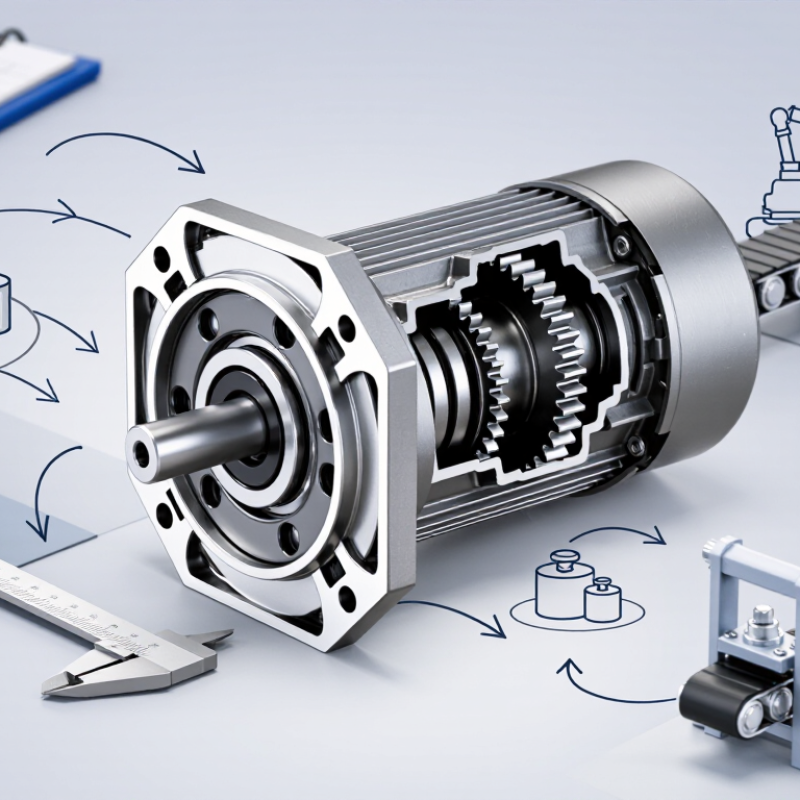
A compact gear motor should fit the application, not merely the available space. Start by recording the required output torque, speed, and movement pattern. Measure the real load carefully. Estimated values can be misleading.
Check whether the motor will start under load or run continuously. A small conveyor may need high starting torque, while a dosing mechanism may require precise, slow movement. Note the duty cycle, reversing frequency, and expected service life. Space is not free. Mounting dimensions, shaft direction, cable position, and gearbox clearance can affect installation.
Environmental conditions also shape the specification. Identify dust, moisture, heat, vibration, and cleaning chemicals near the motor. Confirm the available voltage and controller type before selection. An unsuitable power supply can cause overheating or unstable operation. I have seen compact drives fail because engineers measured running torque but ignored starting torque. That mistake is easy to repeat.
Consider noise, backlash, thermal limits, and braking needs. A medical adjustment device may need quiet operation and controlled stopping. A small gate may need holding torque after power removal. Use a reasonable safety factor, but avoid excessive sizing. An oversized motor can waste space, energy, and money. Test a sample under the actual load, if possible. Real measurements often challenge the original calculation. That is useful. Recheck every assumption before approving the final gear motor.
Record output torque, speed, movement pattern, and actual load. Measure starting resistance carefully. Running torque alone can mislead. Also note duty cycle, reversing frequency, and expected service life.
Some equipment starts while carrying a full load. A small conveyor may need extra torque at startup. A dosing mechanism may need slow, controlled movement. Ignoring starting torque is an easy mistake.
Measure mounting holes, shaft direction, cable position, and gearbox clearance. Leave room for tools and maintenance. A motor can fit the panel but fail during installation. Space is not free.
Check dust, moisture, heat, vibration, and nearby cleaning chemicals. Condensation can cause trouble inside an apparently protected enclosure. A sealed unit may help, but it can add friction and cost. Protection ratings are not magic.
Confirm the available voltage and controller type before ordering. An unsuitable power supply can cause overheating or unstable operation. Check the actual wiring conditions, not only the specification sheet. Assumptions fail quietly.
Use a reasonable capacity margin, but avoid excessive sizing. An oversized motor may waste space, energy, and money. Compare rated torque with starting and continuous loads. More power is not always better.
Face mounting suits compact panels and accurate alignment. Foot mounting provides better access and service space. Flange mounting can reduce movement on a rigid support. Flexible brackets can cause failure.
Steel gears can handle repeated torque and shock well. Hardened teeth may resist wear during frequent starts and stops. Check shafts, bearings, seals, housing finish, and thermal limits together. One strong part cannot repair a weak assembly.
Test a sample under the real load whenever possible. Measure starting behavior, temperature, noise, and stopping performance. Inspect alignment and fasteners after installation. Real measurements may challenge the original calculation.
Choosing the right Compact Gear Motor begins with a clear understanding of the application. Define the required load, duty cycle, operating environment, available installation space, and expected service life. Then match the motor’s torque, speed, and power to the actual load, allowing enough capacity for startup demands and occasional variations without selecting an unnecessarily large unit. The gearbox type and reduction ratio should also be chosen according to the desired output speed, torque multiplication, motion control, and operating pattern.
Beyond basic performance, evaluate the motor’s overall design and suitability for long-term use. Consider its dimensions, weight, energy efficiency, noise level, heat dissipation, and resistance to dust, moisture, vibration, or temperature changes. Mounting options should fit the equipment structure and simplify installation or maintenance. Materials, sealing, lubrication, and expected durability are equally important when comparing solutions. A well-selected Compact Gear Motor should deliver reliable power transmission, stable operation, efficient energy use, and consistent performance throughout its intended service life.
